One doctor was spending thousands every month on Facebook ads and couldn't name a single patient who came from them. The phone rang sometimes, but nobody could say which calls came from ads versus word of mouth.
You need to know exactly where your money goes, which ads produce real patients, and, in healthcare, which rules keep your account from getting shut down. This guide goes through Facebook Ads and how you can use it smartly for your own medical practice.
Key Takeaways
Doctors must follow both Meta's ad rules and HIPAA when advertising.
Poor audience targeting is the top reason doctors waste ad spend.
Facebook and Google Ads serve different purposes for medical practices.
Tracking ROI tells you exactly which ads are driving patient appointments.
Can Facebook Ads actually bring in new patients for doctors?
Over 60% of healthcare marketers call Facebook the most effective social media platform for advertising.
Ads work when targeting, tracking, and compliant creative are all in place. Remove any one of those three, and you're burning budget.
The single biggest money-waster is running an awareness ad when you need direct bookings, or running a booking ad to a cold audience that's never heard of you. Matching the right ad type to your actual goal is where the real savings start.
Are Facebook Ads allowed for doctors?
Yes, doctors can run Facebook Ads. Two sets of rules govern what you can say and who you can target: Meta's own ad policies and federal law.
Ads must be truthful and not misleading. Advertisers need solid evidence for every objective health claim before running it. That guidance comes from the FTC, and it applies to every ad you publish, not just the ones Meta flags automatically.
Meta's Healthcare Ad Restrictions
The biggest changes hit in 2022 and 2025. As of January 2022, Facebook no longer allows ad targeting based on health-condition-related content. Then in January 2025, Meta added new restrictions for the Health and Wellness category, part of a broader initiative rolling through 2026.
Under the 2025 rules, health brands are restricted from optimizing for lower-funnel actions like booked appointments or purchases. You can't tell Meta's algorithm to find people most likely to book.
Elective procedure ads (cosmetic dentistry, aesthetics) have more flexibility than ads touching sensitive health conditions. The restriction is partial, and it changes how you structure campaigns.
HIPAA Rules That Apply to Your Ads
The mistake doctors make the most often involves tracking pixels and patient data.
HIPAA (Health Insurance Portability and Accountability Act, the federal law protecting patient data privacy) requires written patient authorization before using protected health information for any marketing communication. Since April 2003, HHS has received over 349,065 HIPAA complaints. Enforcement is real.
Demographic and interest targeting is fine. Uploading patient lists or using tracking pixels that pass health data to Meta is not.
HHS states that covered entities can't use tracking technologies that result in unauthorized disclosure of protected health information to third-party vendors. Meta doesn't sign a Business Associate Agreement. Uploading patient email lists to Facebook carries serious compliance risk. So treat that as a hard stop.
How to Write Ad Copy That Won't Get Rejected
Meta's ad policies prohibit content that asserts or implies personal attributes, including a viewer's health or medical condition. A headline like "Struggling with back pain?" gets rejected.
Instead, reframe around the service, not the viewer's condition. "Back Pain Relief Now Available at [Practice Name]" says the same thing without triggering a rejection.
"[Service] Now Available at [Practice Name]" (focuses on the offer, not the viewer's health)
"New Patients Welcome: [Specialty] in [City]" (location-specific, no implied condition)
"Meet Dr. [Name]: Accepting New [Specialty] Patients" (builds trust without health claims)
The FTC holds advertisers equally responsible for implied claims in ads, not just what's stated directly.
Skip before-and-after photos in restricted health categories. Avoid graphic medical imagery and misleading outcome claims. Video ads (clinic tours, short doctor introductions) tend to outperform static images because they build trust fast in a scroll-heavy feed.
Targeting the Right Patients Without Wasting Budget
Your ad creative now does more targeting work than your audience settings. This is because Meta's Andromeda system reads the image, video, and copy to decide who sees the ad, which means getting the creative right matters as much as picking the right audience.
Location, Age, and Interest Targeting
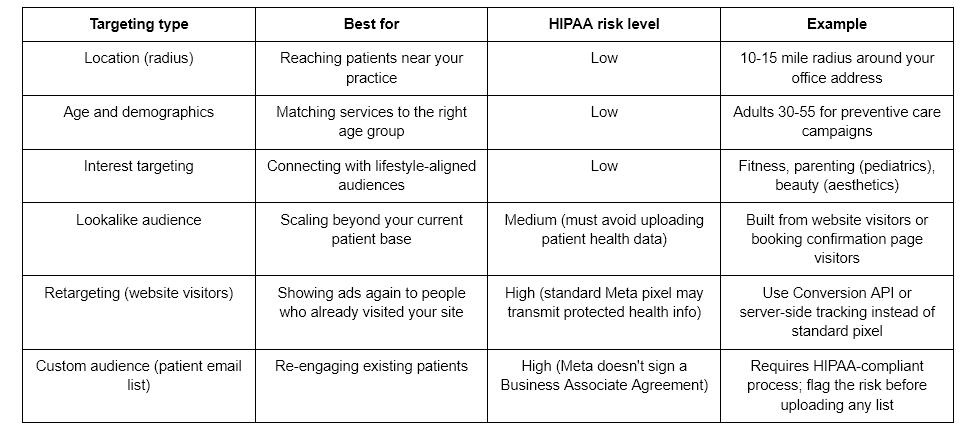
Start with a 10-15 mile radius around your practice address. Facebook Core Audiences targeting covers five areas: Location, Behavior, Demographics, Interests, and Connections. For most practices, location and interests do the heavy lifting.
Fitness and wellness: general practices, orthopedics
Parenting: pediatrics, family medicine
Beauty and skincare: aesthetics, dermatology
Health condition targeting is restricted. Don't try to target people interested in "diabetes" or "chronic pain." Focus on lifestyle interests instead.
How big should your audience be?
Aim for 50,000-250,000 people in your target audience. Too narrow (under 20,000) drives up your cost per thousand impressions because Meta has fewer people to show your ad to. Too broad (over 500,000 in a local market) pulls irrelevant clicks from people who'll never visit your office.
Facebook Audiences Built From Similar Patients and Website Visitors
A lookalike audience (a Facebook audience built from people similar to your current patients) lets you scale beyond your local list. Facebook takes a source audience and finds people with similar attributes. Build yours from website visitors or people who reached your booking confirmation page.
Retargeting (showing ads again to people who already visited your website) is powerful but carries real compliance risk in healthcare. HHS states covered entities can't use tracking technologies that result in unauthorized disclosure of protected health information to third-party vendors.
The standard Meta pixel may transmit protected health info from your website to Facebook. Instead, use Meta's Conversion API or server-side tracking.
If you're just starting out, location and interest targeting give you the lowest risk and the fastest launch. Add lookalike audiences once you have enough website traffic to build a meaningful source list.
Ad Formats That Work Best for Doctors
Video, carousel, and lead form ads consistently outperform static images in healthcare campaigns.
Video ads (clinic tours, "Meet the Doctor"): consistently deliver the lowest cost per lead in healthcare campaigns. Keep videos to about 15 seconds for mobile viewers with short attention spans.
Carousel ads: show multiple services in one ad. Good for practices offering several specialties.
Lead form ads: let patients book or request info without leaving Facebook. Reduces friction.
98.5% of U.S. Facebook users access the platform on mobile devices. This means every ad must load fast, use vertical video, and link to a mobile-friendly landing page or instant form.
The campaign types that work best for practices are new patient specials, short educational Q&A videos, patient testimonial ads (with written consent), and community involvement posts.
How much do Facebook Ads cost for doctors?
$500-$1,000 per month is the right starting budget for doctors testing Facebook Ads. Run that for at least 30-60 days to gather usable data before scaling.
Broader ranges:
$500-$1,500/month for a small test
$1,500-$5,000/month for consistent lead generation.
As always, your specialty, location, and competition all matter here.
But you shouldn’t be looking primarily at ad spend. Instead, track your patient acquisition cost (aka, how much you spend in marketing for each new patient). Healthcare Facebook Ads show an average cost per link click of $1.32 as a benchmark. Your goal is to get close to that number.
But clicks aren't patients. Expect $30-$75 per lead for most specialties and $75-$200+ for competitive elective procedures like dental implants or aesthetics.
You should also know that budget alone doesn't determine results. A practice spending $1,000/month with sharp creative and tight targeting will outperform one spending $5,000/month on generic ads sent to the homepage.
Here’s a rough budget guide for Facebook ads:
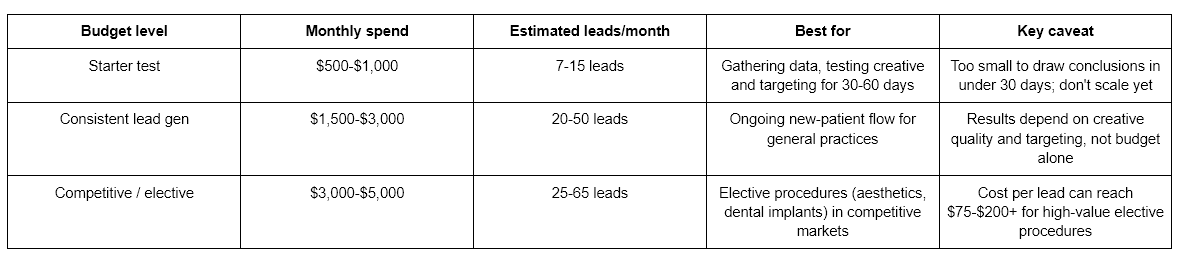 If you're spending under $1,500/month, you're in data-gathering mode. Use that phase to test creative and audiences before committing more.
Get 30 New Patients in 60 Days. Booked appointments you can trace to every dollar of spend. Get your FREE consultation.
How to Track ROI and See Which Ads Bring In Patients
Four tracking steps will show you exactly which ads produce booked patients.
Meta now limits conversion tracking for advertisers it categorizes under Health and Wellness. Platform data alone is unreliable for measuring results.
1. Install Meta's Conversion API (not just the pixel) The standard Meta pixel may transmit protected health info. Use server-side tracking or Conversion API to stay HIPAA-compliant and still measure ad results.
2. Create a dedicated landing page for each campaign Don't send ad traffic to your homepage. Build a separate page with one clear action (a booking form or phone number) so you can track exactly which campaign drove each lead.
3. Use a call tracking number unique to Facebook ads Assign a dedicated phone number that only appears in your Facebook campaigns. This lets you count phone-call leads separately from other marketing channels.
4. Review cost per lead and cost per booked patient weekly Ignore vanity metrics like impressions and likes. Focus on cost per lead ($30-$75 is typical for most specialties) and cost per booked patient. If leads aren't turning into appointments, fix your follow-up before touching the ads.
Click-through rate (the percentage of people who click your ad) tells you whether your creative and targeting are working. Healthcare Facebook Ads average a 0.83% CTR. The cross-industry median sits around 2.19%.
Healthcare runs lower because of ad restrictions, so don't panic if you're below 2%. Below 0.83% signals a creative or targeting problem that needs fixing.
The real measure of success is whether ads produce kept appointments and revenue. ROAS, cost per result, and conversion rate all matter as diagnostics, but weight cost-per-booked-patient above everything else. Platform-reported ROAS can be unreliable for health advertisers.
Why your ads aren't getting leads (and how to fix it)
Sending traffic to your homepage is the most common and most costly mistake. No clear call to action, no tracking, no way to measure results.
Is Your Facebook Ad Actually Broken?
Based on the following scenarios, here’s what could be happening:
CTR below 0.83%: Your creative or targeting needs work. Test new ad copy, images, or video.
Leads are cheap but nobody books: The bottleneck is your follow-up process. Call leads within 5 minutes.
Cost per click above $1.92: Your audience may be too narrow, or your ad relevance score is low. Broaden targeting to 50,000-250,000.
No data after 7 days: That's normal. Most ad creative fails in testing. Wait at least 30 days before deciding.
If leads aren't becoming appointments, try to fix the follow-up before blaming the ad.
Targeting too broad or too narrow: either you're reaching people who'll never visit, or you're paying premium rates for a tiny audience
Weak or non-compliant ad copy: gets rejected by Meta or ignored by patients
No conversion tracking installed: you can't measure what you can't see
Homepage traffic instead of a dedicated landing page: no clear action, no way to attribute leads
Giving up after 7 days instead of testing for 30: the algorithm needs time to optimize delivery
Instant forms get more leads but lower intent. Dedicated landing pages get fewer leads but higher intent. Test both. Compare cost per booked patient, not just cost per lead.
Facebook Ads vs. Google Ads for Doctors: When to Use Each
If your practice needs patients now, prioritize Google Ads. If you're promoting elective services or building community visibility, start with Facebook.
The best results come from running both together: Google captures people already looking, and Facebook warms up future patients who aren't searching yet.
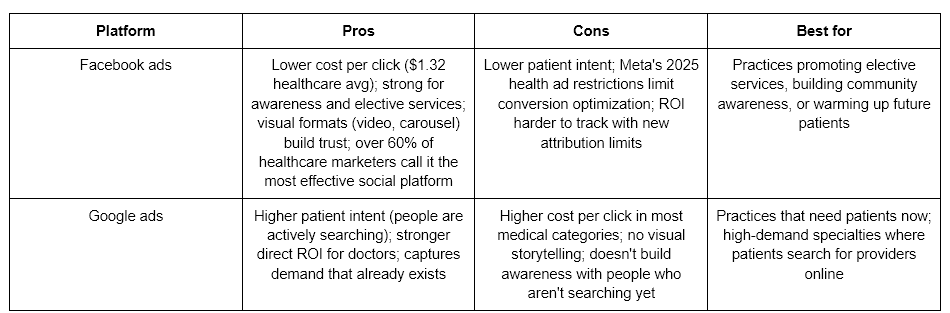 Facebook and Instagram ads work for medical practices, but overall ROI from Google search ads tends to be higher. Facebook is stronger for awareness and nurturing.
Why Most Doctors Hire Experts to Run Their Ads
Running compliant, effective Facebook ads for doctors takes 5-10 hours per week. That covers setup, monitoring, creative testing, and optimization. Most doctors don't have that time between patient care and running a practice.
One of our clients added 40 new patients per month within a quarter after we restructured their targeting and tracking with the Digitalis Growth System.
Red Flags When Evaluating an Agency
No HIPAA awareness: they can't explain how they protect patient data in ad campaigns
No conversion tracking: they don't measure cost per booked patient
Reporting only vanity metrics: impressions and likes instead of leads and appointments
Long-term contracts with no performance benchmarks: no accountability for actual results
Your Ads Should Tell You Exactly Which Patients They Brought In
Most wasted ad spend traces back to two problems: wrong targeting and no conversion tracking. Fix those, and your campaigns either start working or clearly tell you to move your budget elsewhere.
Request a free ad account analysis to see how many patients your current spend should be producing, and where the gaps are. Contact our team to get started.
Frequently Asked Questions
Do Facebook Ads actually bring more patients to a medical practice?
Yes. Over 60% of healthcare marketers call Facebook the most effective social platform. Ads reach new patients who've never heard of your practice.
How much should a doctor spend on Facebook Ads each month?
Start at $500-$1,000/month for 30-60 days. That's enough to test creative, gather real data, and decide whether to scale.
What's the difference between broad and narrow targeting for doctor Facebook Ads?
Aim for 50,000-250,000 people. Narrower audiences drive up costs. Broader audiences pull irrelevant clicks from people who'll never visit your office.
Can doctors use patient email lists to build Facebook audiences?
No. Meta doesn't sign a Business Associate Agreement. Uploading patient lists carries serious HIPAA risk. Use website visitors instead.
Can doctors use Facebook audiences built from people similar to their current patients?
Yes, but build them from website visitors or booking page visitors, not patient health data. That keeps you on the right side of HIPAA.
Is showing ads again to people who already visited your website safe for doctors?
It's powerful but risky. The standard Meta pixel may transmit protected health info. Use the Conversion API or server-side tracking instead.
What does Facebook Ads cost per lead for doctors?
Expect $30-$75 per lead for most specialties. Competitive elective procedures like dental implants or aesthetics can reach $75-$200+.
How do doctors know which Facebook Ads are actually producing patients?
Use a dedicated landing page per campaign and a unique call tracking number. Track cost per booked patient, not impressions or likes.
What's a normal click-through rate for healthcare Facebook Ads?
Healthcare averages 0.83%. Below that signals a creative or targeting problem. The cross-industry median is 2.19%, but health ad restrictions pull healthcare lower.
Should doctors use Facebook Ads or Google Ads?
Google captures patients already searching. Facebook builds awareness before they search. Elective services perform well on Facebook. Practices needing patients now should prioritize Google.
Need help with social media ads?
Get a custom strategy built on clinical experience — not generic marketing playbooks.
