
Key Takeaways
Most functional medicine practices lose patients due to vague, unclear messaging.
A weak website with no call-to-action is one of the costliest marketing mistakes.
Local SEO and Google Business Profile are critical for patient discovery.
Social media alone is not enough to reliably grow a functional medicine practice.
FDA, FTC, and HIPAA compliance rules directly affect how you market your practice.
You spent $3,000 on Facebook ads last quarter. You got 40 leads, but only two booked a consult, and zero became patients. Sound familiar? The problem isn't your clinical work or your prices. It's that most marketing advice you've read was built for insurance-based clinics, not cash-pay functional medicine practices. Patients spend months researching before they pick up the phone.
The U.S. functional medicine market is now worth $66 billion and growing double digits every year. Yet most practitioners still rely on word-of-mouth or copy-paste tactics from general medical digital marketing playbooks. Meanwhile, patients searching for root-cause answers are already on Google, scanning reviews, and comparing practitioners.
The 8 Marketing Mistakes Costing Your Practice New Patients
Generic marketing fails functional medicine because patients have longer decision cycles and need education, trust, and personalization before they book.
65% of patients go online before booking a health appointment, which means that to even be considered, you need search visibility.
1. Vague messaging about who you help
"We help people feel better" doesn't help anyone self-select. Patients need to clearly understand who you are and which types of people you serve before they'll trust you with their health.
Compare that to "we help women 35-55 with hormone imbalance and gut issues." One bounces. The other books.
Fix: define your niche (covered below).
2. No clear call-to-action on your website
Visitors who can't find a "Book a Consult" button above the fold leave. Strong calls to action like "Schedule a Free Wellness Assessment" or "Take Our Symptom Quiz" give patients a simple next step.
Without one, your traffic costs you money without producing patients.
Fix: rebuild the website to convert (covered below).
3. Generic website with no personal story
Cash-pay patients are choosing the practitioner, not the practice. 81% of people say trust is required before they'll buy, and the bar is higher for healthcare.
A template site with stock photos and no founder bio tells patients you could be anyone.
Fix: add your personal story and credentials (covered below).
4. Ignoring local SEO and your Google Business Profile
46% of Google searches are local. Most clinics never fully claim or optimize their GBP (Google Business Profile, the free listing that appears when someone searches for your business on Google).
That's a free patient channel sitting unused.
Fix: optimize your GBP (covered below).
5. Relying only on social media
Social media is rented land. One algorithm change and your organic reach can drop overnight (practices that learned this the hard way had no backup pipeline).
Fix: build email as your owned channel (covered below).
6. No lead magnet or email follow-up
Functional medicine has a long sales cycle. Research across industries consistently shows most buyers need multiple touchpoints before they convert, and functional medicine's long consideration window makes this especially true.
Without a lead magnet and a follow-up sequence, most of the interest you generated goes cold.
Fix: build the email funnel (covered below).
7. Skipping patient testimonials or posting them wrong
Posting a patient's story without written authorization is a HIPAA (Health Insurance Portability and Accountability Act, the federal law governing patient data privacy) violation.
The Privacy Rule requires written patient authorization before any protected health information can be used for marketing.
Fix: the compliant testimonial process (covered below).
8. Not tracking what's actually working
Only 1% of healthcare marketers can connect more than half of their spend to patient conversions — most practices are flying blind.
Without tracking, you can't tell which channel produced the patient, so you can't cut what isn't working.
Fix: the 5 KPIs to track monthly (covered below).
Why Functional Medicine Marketing Is Different
Functional medicine marketing isn't a variation of standard medical marketing. It's a different category with different rules. Four structural differences change how every tactic must work:
Payment model: Cash-pay, no insurance referrals driving volume. Every patient is a direct decision.
Sales cycle: Longer and education-driven. Patients research for weeks or months.
Trust threshold: Higher. Personal buy-in to the practitioner is required, not just convenience.
Compliance load: FDA and FTC scrutiny on supplements and health claims is heavier than for general practices.
Practices that regularly publish blog content see 126% more lead growth than practices that don't. That growth depends on credibility.
Only 19% of U.S. adults trust general online health information, but 62% trust it when it comes from a health professional. Credentials and named authorship on every piece of content are what flip that ratio in your favor.
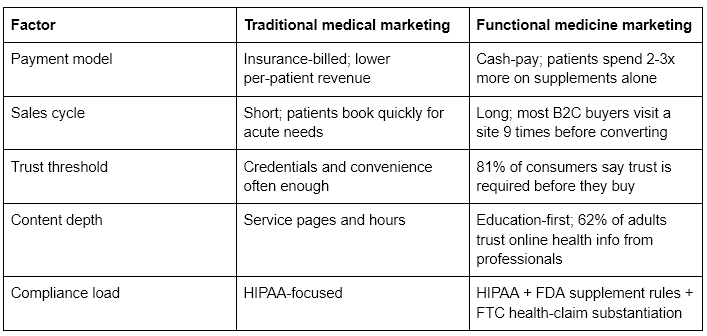
Niche and trust come before any paid spend, in that order.
Define Your Niche and Ideal Patient First
A defined niche cuts your patient acquisition cost (i.e., how much you spend per new patient booked).
A practice that markets to "anyone with health issues" pays not only for clicks from their target audience, but also people who will never book.
A practice that markets to “women 40-55 with hormone and thyroid issues” pays only for the people most likely to convert.
Patients rarely search for abstract concepts like "functional medicine philosophy." They search for help with specific symptoms: fatigue, weight resistance, perimenopause, brain fog, autoimmune flares. Your niche should match how patients actually describe what they're looking for.
Use this 3-question filter to find yours:
Who do you treat best? The conditions where your protocols produce the strongest results.
Who pays cash willingly? The demographic with both the need and the means to invest.
Who refers friends? The patients who turn one consult into three.
Personalization builds trust by acknowledging patient priorities, challenges, and individual health beliefs. A clear niche makes that personalization possible from the first ad impression onward.
Build a Website That Converts Visitors Into Consults
You spent money to get the click. The website decides whether that click becomes a consult.
Most visitors arrived from a Google search. They're comparing you to two or three other practitioners in the same tab. Your site needs to pass Google's E-E-A-T (Experience, Expertise, Authoritativeness, and Trustworthiness, Google's quality framework for health and financial content) standard. Health content also falls under YMYL (Your Money or Your Life, Google's label for content that can affect a person's health, finances, or safety). Google holds it to a higher bar than ordinary content.
North Valley Women's Care went from 0 to over 1,000 patients in 2 months. They rebuilt their website with the Digitalis team.
Clear Calls-to-Action Above the Fold
Put one primary action on every page, visible without scrolling. "Book a Free Discovery Call" is the standard. Calls to action move visitors from interest to booking, and a single clear CTA outperforms three competing ones every time.
Your Personal Story and Founder Bio
Patients choose practitioners, not practices. Your bio should cover your credentials, your training, and the "why" behind your work. Include the case that changed how you practice, the family member whose diagnosis pulled you into functional medicine, or the moment conventional care failed someone you cared about. Strong healthcare branding strategies treat this founder narrative as a core asset. That's what closes a cash-pay consult.
Testimonials and Case Studies Done Right
Get written patient authorization before publishing any story. Anonymize identifying details so the content can't be traced back to a specific individual. For video testimonials, use a signed release that names every platform where the video may appear. Health information is only de-identified when it doesn't identify a person. You must also have no reasonable basis to believe it could be used to do so. When in doubt, get the signature.
Local SEO and Your Google Business Profile
A fully optimized Google Business Profile is the fastest free source of new local patients for most functional medicine practices. Nothing else you can do this week produces patients faster at zero ad spend.
Patients who booked healthcare appointments ran 3 times more searches than those who didn't book. They're comparing, reading, and filtering before they ever pick up the phone. 77% of patients use online reviews as their first step in finding a new doctor. Your GBP is where most of those reviews live.
Appearing in Google's top 3 local results changes patient volume more than any other ranking shift. Most clicks go to those three spots. Everything below the map is an afterthought.
Claim and Fully Complete Your Profile
Fill in every field Google offers. Categories, services, hours, photos of your office and team, and the Q&A section. Post weekly updates so the profile signals activity.
Keep Your Name, Address, and Phone Number Consistent Everywhere
Keep your name, address, and phone number consistent everywhere: on your website, Yelp, Healthgrades, and every directory listing. Even small mismatches like "Suite 200" versus "Ste. 200" hurt local rankings because Google can't confirm you're one business.
Build a Steady Review Flow
Ask every happy patient for a review the same day they leave the office. 94% of healthcare patients use online reviews to evaluate providers, so review volume directly drives booked consults.
Respond to every review, but never confirm someone is a patient or share any health detail, because even acknowledging treatment violates HIPAA.
SEO Keywords and Realistic Timelines
SEO takes 4 to 9 months to deliver consistent new patients.
Most websites see impressions and traffic start improving within 4 to 6 months. More substantial gains often take closer to a year. It’s worth it if you’re patient, since SEO keeps producing patients after the initial investment stops. Turn off Google Ads and leads stop tomorrow. Stop active SEO work and rankings hold for months.
The keywords that work for functional medicine fall into four categories:
Condition + city: "SIBO specialist Phoenix"
Treatment + city: "hormone therapy Scottsdale"
High-intent near-me searches: "functional medicine doctor near me"
Diagnostic-driven searches: "SIBO testing Phoenix"
Months 1-3: Foundation and setup
Fix technical site issues, claim and optimize your Google Business Profile, publish core service pages, and target condition + city keywords. Expect impressions to start climbing but minimal new patients yet.
Months 4-6: Ranking growth
Blog content begins ranking, Google's top 3 local results start showing your clinic, and review volume builds. Moz reports most websites see meaningful traffic gains in this window.
Months 7-12: Patient volume
Compounding content, links from other websites, and review momentum drive consistent booked consults. Substantial gains typically take closer to a year. Practices that invest in SEO for medical practices during the foundation phase consistently reach this stage faster than those who delay.
The first 3 months are foundation work, so it’s best not to judge ROI until month 7.
See what's working for functional medicine practices right now. Get a $0 website analysis from the Digitalis team: clinicians and marketers who only work with healthcare. Book your analysis
FDA, FTC, and HIPAA Compliance: What You Cannot Ignore
Most marketing content skips compliance because it's complicated. That is exactly why practices that get it right pull ahead of the ones that don't.
Three regulators shape every piece of functional medicine marketing. The FTC requires health benefit claims for supplements to be backed by competent and reliable scientific evidence. If you use a patient endorsement, the FTC also requires you to disclose what typical results look like, not just the best outcome.
The FDA and FTC judge the overall impression of your marketing. Below is a quick guide for specific marketing scenarios and how to stay compliant.
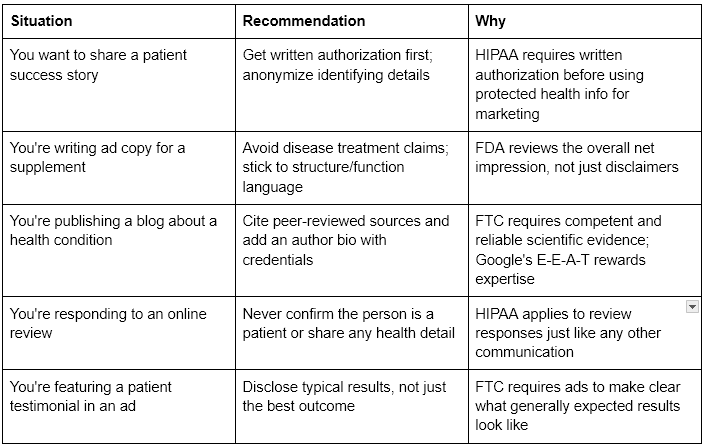 HIPAA defines marketing as any communication that encourages someone to buy or use a product or service. Written authorization is required before you use any protected health information for that purpose.
Marketing claims in alternative medicine are frequently unsupported by sound evidence, and patients aren't positioned to evaluate them. Compliance protects them and your practice.
Tracking ROI: The 5 Numbers That Matter
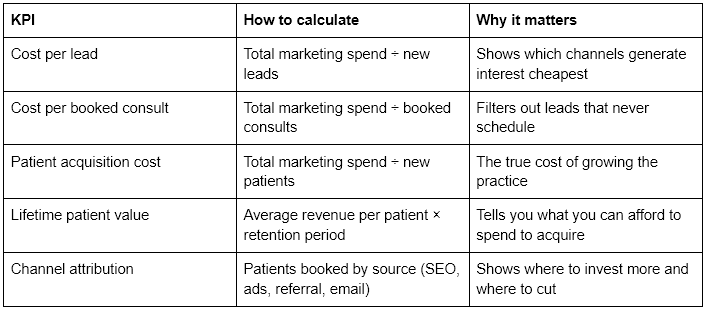
Without these 5 numbers, you can't fairly evaluate any marketing channel (including Digitalis).
Only 1% of healthcare marketers can connect more than half of their spend to patient conversions. If you don't know what each channel produces, you can't cut what isn't working or double down on what is.
Track opt-ins, bookings, show-ups, and enrollments every week.
 Run the Sequence in Order: Niche, Website, Local SEO, Email, Then Ads
The sequence is the strategy. Niche first, then website, then local SEO, then email, and ads last. Education-first marketing works for functional medicine because patients research deeply before booking, and each step earns the next one's effectiveness.
Prescott Medical Aesthetics doubled their patient volume in 6 months by following this sequence with the Digitalis team. If you've already wasted spend on ads without a niche or a converting website, start with a $0 website analysis. Contact our team to get yours scheduled today.
Frequently Asked Questions
How long does functional medicine SEO take to deliver new patients?
Expect 4 to 9 months. Impressions start climbing in months 1 to 3. Consistent booked patients typically arrive by month 7.
What are the biggest functional medicine marketing mistakes private clinics make?
Vague messaging, no clear call-to-action, and skipping local SEO are the top three. Each one costs real revenue every month.
What are the do's and don'ts for marketing supplements as a functional medicine doctor?
Use structure/function language. Never make disease treatment claims. The FTC requires solid scientific evidence behind every health benefit claim you publish.
How do I collect and showcase patient testimonials without violating HIPAA?
Get written authorization first. Anonymize identifying details. Never confirm someone is a patient when responding to a review publicly.
How do I know which marketing company is right for my functional medicine practice?
Track cost per lead, cost per booked consult, and patient acquisition cost monthly. Vendors who avoid those numbers aren't worth hiring.
What does a personal story actually do for my marketing?
Patients choose practitioners, not practices. Your "why" converts cash-pay consults because 81% of people say trust is required before they'll buy.
What is the right order to run functional medicine marketing tactics?
Niche first, then website, then local SEO, then email, then ads. Skipping steps wastes ad spend on a foundation that can't convert.
How important is my Google Business Profile for getting new patients?
It's the fastest free patient source available. 77% of patients use online reviews first, and most live directly on your GBP.
What are the 5 numbers every functional medicine practice must track?
Cost per lead, cost per booked consult, patient acquisition cost, lifetime patient value, and channel attribution. Track all five monthly.
How does functional medicine marketing differ from standard medical marketing?
It's cash-pay, trust-heavy, and compliance-loaded. Patients research for weeks and need multiple touchpoints before they book.
Need help with marketing strategy?
Get a custom strategy built on clinical experience — not generic marketing playbooks.
